Showing posts with label prevention. Show all posts

Wednesday, December 1, 2010

World AIDS Day

Today is World AIDS Day. While I typically blog about eating disorders, body image and beauty, I sometimes like to take a minute to write about other things that are on my heart! And today, this is one of them.

Last night, I was talking to one of my best friends who lives in Chicago... we don't always have the best luck connecting via phone (she is a resident who works nights sometimes- think Grey's Anatomy) but when we do, we usually laugh a lot and have really good conversations about our lives. We share a passion for Africa, and she introduced me to vanilla chai (my favorite) at the first Student Global AIDS Campaign meeting we went to in college- thanks, Ali:). She is currently an OBGYN resident at Northwestern- and is one of the smartest, funnest girls I know. Well this past year, through a series of chaotic circumstances one night at work, she ended up getting stuck with an HIV infected needle. I was scared when she asked me to pray for her, but thankfully, the risk of contracting HIV this way is very low. Still, as small as the risk was, there was still a chance that she could be HIV positive... and that was scary! After several tests (and weeks of anti-retroviral drugs), her results came back negative. I was and still am so thankful that she is ok! (So is her husband!:))

In light of it being World AIDS Day, I was thinking about how lucky she was to have access to ARV drugs. These drugs are expensive and not everyone has access to them. The theme this year for World AIDS Day 2010 is 'Universal Access and Human Rights.' Human rights violations (sex trade and trafficking) fuel the incidence of HIV. The focus this year is on protecting human rights while also working to provide better prevention efforts globally as a means of cutting the occurrence of transmission. Take some time today to think about your health, your body, your rights as a person, and consider how you might help someone who isn't as fortunate to have what you do. To learn more about World AIDS Day, and ways that you can get involved, follow this link.

Wednesday, November 17, 2010

How Far Does the Thin Ideal Extend??

According to a recent study published, preschool aged girls- as young as 3!!- indicate a preference towards thinness. How is that even possible??! I was actually skeptical when I saw this headline! But as I read this study (here!), it all started sounding way too believable. I obviously get that media has an impact upon how we define beauty, and I also am all too familiar with the ways in which modeling can influence us. I'm not talking about supermodels walking the runway... but about behaviors and attitudes that we pick up on by observing those around us. Anyways, in this study, the researchers tried to determine the childrens attitudes about weight by watching them choose game pieces (for board games like Candyland- my favorite!) that they had specifically constructed- a thin girl, an average girl, and an overweight girl. They watched the girls choose the pieces and interact with them, and asked them about the pieces as well. While it is very difficult to study body issues and perceptions in 3 year olds, there were some pretty strong reactions among the children to the game pieces. Some of them were very reluctant to play the game using the overweight girl game piece, and the majority would have rather been the average girl if they could not be the thin girl. To read more of the findings regarding the study, follow the link above- or here!

So what can we do in the face of some discouraging news about innocent little girls picking up on the thin ideal at the age of 3 years old?! Well, I think that regardless of whether or not we have children, nieces/nephews, interact with children daily, etc.. there are things that we can do. First, emphasize health over weight. Helping children (and ourselves, really!) to place the focus on our bodies being strong and able to engage in activities that we enjoy takes the focus off of a number. Second, avoid fat talk! What is fat talk?? Anything that reinforces unhealthy beliefs and attitudes about our bodies. ("I look SO fat in this!" "Oh, wow, you look great, have you lost weight?" "I need to lose ten pounds" "She's too fat to be wearing that") I have written a lot about fat talk before- check out this link or this one for more info! Lastly, if you do have children or if you are ever around kids, encourage and affirm them for who they are- their personalities, their character traits, positive things that they have done, their interests- rather than how they look! This extends to us grown-ups as well:) I think that if we can start to redefine beauty (and the thin ideal) by focusing on beauty as more than just our looks (by focusing on our hearts, our minds, our faith), then we might begin to know our true worth and value.

Thursday, October 14, 2010

In honor of Fat Talk Free Week coming up (it starts Monday!), I wanted to point you to a few great reads that have been published online in the last few days. The first is an article that I just read-- a very empowering and bold interview given by plus size model and winner of America's Next Top Model cycle 10, Whitney Thompson. She is very outspoken about her role in the modeling industry as a voice of change and as one promoting healthy body image. In fact, she is an ambassador (aka- spokesperson) for the National Eating Disorders Association, NEDA. It is def worth checking out; Sunny Gold's article and interview with Whitney can be found by following this link to the Huffington Post (what else?!).

The other article is one that was just published in Newsweek and has been getting a lot of attention. Newsweek wrote an article mentioning Fat Talk Free Week- a pretty big deal, as far as creating awareness! It's a great article that defines the essence of Fat Talk Free Week. Check it out here. And in the meantime, consider how you can start cutting the fat talk out of your life. Start small! More to come in the next few days!

Monday, October 4, 2010

On Asking For Help-- And A Horse Named Dude

Last week, I took a little road trip to Virginia where I attended an onsite visit at Remuda Ranch. Remuda is a residential treatment facility for girls and women with eating disorders- they just recently updated their website, and it's worth checking out (follow this link to view it!). Anyways, while I knew quite a bit about Remuda Ranch before visiting, I was really impressed with the quality of care that they provide to patients. I was also impressed with the commitment and value placed on spiritual healing as well! Remuda's treatment program is centered around a Christian approach, however, girls and women of all faiths are respected and welcome and can decide how little or how much they want to participate and interact with the faith piece.

Anyways, Remuda really is a ranch- it's not just called that:-). There is a full service barn complete with horses. No cell phone service, no Starbucks, and nothing but dirt roads and beautiful scenery. Among the therapeutic activities used with patients is equine therapy, which uses experiences and interactions with horses to teach the patients things about themselves, facilitating insight and growth. I was a little skeptical before I really knew anything about it, but after learning more and seeing different demonstrations, it is amazing how much you can learn about yourself from a horse!

I volunteered to help out with an activity and got to meet Dude, an Arabian horse:-). My task was to get him over a jumping bar without touching him. Last time I checked, I wasn't a horse trainer-- and I had NO idea how to make this happen. Once I was in the ring with Dude, I secretly regretted volunteering because I was feeling a little in over my head!! After several frustrating minutes of Dude eating dirt and ignoring my commands to jump over the bar, I finally asked Dave, the man in charge, if he had any suggestions! He didn't (of course), but some of the other therapists that were watching were able to give me some ideas. They told me to take the bar off of the jumping post, and lay it on the ground and have Dude walk over the bar. After much coaxing and guiding him from behind, Dude finally stepped over the bar!!

After processing what happened with Dude (I love that the horse's name is Dude, by the way), Dave mentioned that this particular activity can be useful in illustrating how important it is to ask for help!! He said that he will watch people struggling with an activity like this, not knowing what to do, and watching them get frustrated (like me!), and angry- and yet they don't ask for help. Or, if they do, they wait a really long time before asking. You might see how this applies to eating disorder recovery, and even more so, life!! We were not created to be alone, to have no support or community in our lives. And yet sometimes our pride or life circumstances keep us from reaching out and asking for help! Sometimes admitting we need help and are unable to do things on our own can be a huge step forward... and what a relief to know that we don't have to carry a burden all on our own! Sometimes we don't ask for help because we're not even sure of what we need! But just being able to share a burden with a friend, family member or loved one can be a way of reaching out for help and support.

Saturday, September 25, 2010

A History of Our Bodies and Beauty

One thing I have been thinking about lately is trends. They come and go, but while a trend is hot, a majority of people (not everyone, but a lot of people) follow whatever is popular- whether it be a clothing style, accessories (silly bandz anyone?), music, a book or author, electronics, etc. Just an FYI- I'm not knocking on following trends, because let's face it, I'm blogging :)

But as I have been thinking about trends, one thing that has really hit home is the way that 'beauty' and our bodies have been subjected to trends over time. For example, in the early 1900's, Victorian women wore corsets (pictured to the left) in order to make their waists appear smaller for the expressed purpose of accentuating their hips and butt, and to give them the illusion of being rounder and fuller. 20 years later, flapper girls were binding their breasts and working to achieve a boyish figure, thin and straight. 30 years later in the 1950's, Marilyn Monroe was THE icon of beauty. It surprises many people that she was a size 16. She had curves, and her body was the ideal.

It is important to note, as an aside, that throughout the shifts in trends with bodies and beauty, most of us women have tried hard to emulate them, no matter how radical the shift. Case in point, only 10 years later, Twiggy, the super skinny model (hence the name Twiggy) was all the rage and people wanted to look just like her! While thinness and weight loss have continued to be trends since that time, the 1980's were a time in which being fit and toned was considered ideal (Jane Fonda anyone?). When the 1990's rolled around, Baywatch Babe Pamela Anderson was a global icon- she was skinny with huge boobs, which became a major trend in the 90's. If you look around now, the majority of these 'looks' or 'ideals' seem to be outdated, meaning they are no longer in style. How do our bodies and beauty go out of style?

One thing that I have been thinking about is the sheer absurdity of our natural bodies (and how we define beauty) as being defined by trends. Surely, fashions change, and how we wear our makeup and clothes, etc, will change. But I think that we must learn to accept our bodies as they are, and celebrate them as they are because otherwise, we will have a relationship with our bodies that forces us to adapt and change with the trends, meaning we are never able to accept ourselves as we are. The only way for us to feel beautiful is to change ourselves. When the trends begin to change, we must change in order to accept and like ourselves and our bodies. That just seems backwards. It doesn't mean that we all don't ever play into the dynamic of trends, but I think that in considering the history of beauty and our bodies, we may see that beauty is something that goes way deeper, and cannot be defined by trends. If the ideal of beauty is changing every 10, 20, 30 years, maybe we should at least consider defining beauty in ways that don't change. It might help us be more confident, it might help us to accept ourselves and consequently, really love who we are! Think about it, and see what you come up with. Would love to hear your thoughts!

**(History/facts taken from thesite.org)

Tuesday, June 29, 2010

The Joy Project

Help those suffering from eating disorders by voting for the Joy Project in Pepsi's Refresh Project! Pepsi has organized this project as an opportunity for people, businesses and non-profits to share ideas that will make a positive impact on communities. Anyone can submit an idea, as well as vote! And, there are only 2 days left to vote before they start a new month over and , so if you are interested, you may want to check it out soon!! The Joy Project is currently ranked #64 and needs some more votes (quickly) if they are going to receive some funding!!

The Joy Project is seeking 25k to fund a program called Roots of Recovery- the money is being used to rent a meeting space to conduct their meetings and activities, as well as fund the activities and meetings! They are not providing therapy or nutrition services, and are not licensed clinicians. However, they are interested in providing support, education and research- all things that are needed in the field of eating disorders! If you are interested in finding out more about the Joy Project (or voting), follow this link. To check our the Joy Project's website, follow this link.

Monday, May 31, 2010

Athletes and Eating Disorders- Part 2


If you missed part 1 of Athletes and Eating Disorders, you can scroll down a little to read it, or you can click here! I had the honor of interviewing Nancy Matsumoto (co-author of The Parent's Guide to Eating Disorders and a free-lance writer in NYC--follow this link for more on Nancy!), who is working on completing Toolkits for NEDA (National Eating Disorders Association) that are geared towards coaches and trainers. Both disordered eating and eating disorders impact many athletes, and one of the ways to promote health amongst athletes is to educate coaches and trainers, who are in unique positions of influence to point athletes towards the proper treatment and care of their bodies. Nancy, in my previous post, mentioned a phenomenon called the Female Athlete Triad, that I wanted to expand on (courtesy of NEDA).
Below is NEDA's description of this term/phenomenon:

The Female Athlete Triad includes 1) disordered eating, 2) loss of menstrual periods and 3) osteoporosis (loss of calcium resulting in weak bones). The lack of nutrition resulting from disordered eating can cause the loss of several or more consecutive periods. This in turn leads to calcium and bone loss, putting the athlete at greatly increased risk for stress fractures of the bones. Each of these conditions is a medical concern. Together they create serious health risks that may be life-threatening. While any female athlete can develop the triad, adolescent girls are most at risk because of the active biological changes and growth spurts, peer and social pressures, and rapidly changing life circumstances that go along with the teenage years. Males may develop similar syndromes.

The Female Athlete Triad puts female athletes at risk, and also inhibits their athletic performance. I am glad Nancy mentioned this because it is something that not many people know about (even in the field of eating disorders!). Below are the last few questions/answers of my interview with Nancy- I hope that you will find this informative (like I have)!

Me: What are some things that you have been struck by or learned about eating disorders and athletes through this process?

Nancy: One thing I’ve learned about athletics and eating disorders is that for the coach, the line between encouraging athletes to achieve peak performance levels and promoting unhealthy eating and training behaviors is blurred. For this reason, when coaches and trainers, are told they need to be more vigilant in spotting and addressing dangerous behaviors it can sound to them like their ability to do their jobs is being questioned and curtailed. They want to create winning athletes, and the traits that create champions—perfectionism, the desire to please coaches, and strong drive to succeed—are those often associated with eating disorders. They may fear that in order to encourage healthier behaviors among their athletes, they will have to discourage the very traits that make their athletes excel. What we hope the Toolkit will do is show that the better nourished and healthier the athlete is, the better her or his performance will be, and that although eating-disordered behaviors may seem to improve performance in the short run, in the long run they do not support athletic excellence.

Me: For many elite athletes who are competing at world class levels (whether collegiately, professionally, in the Olympics, etc), particularly in sports that may encourage (implicitly or explicitly) a high degree of scrutiny over body composition and weight for performance purposes (gymnastics, ice skating, running, wrestling, etc), eating disorders and disordered eating are increasing. Do you have any thoughts about how we might work towards helping athletes approach their performance and bodies from a more healthy standpoint?


Nancy: Yes, education and support for both athletes and coaches is very important. Some coaches are still not fully aware of the risks for and dangers of eating disorders among their athletes. We hope that once they do understand the facts, they will be open to discussing these risks with the team, stop making negative comments about weight or size, establish a zero tolerance policy for eating disordered behaviors, and foster a climate in which an athlete feels she or he can discuss these issues without fear of reprisal. For athletes, it’s great to have a sports nutritionist speak to the team about the importance of adequate fueling and hydration in their sport, to go over the warning signs for problem eating and exercise behaviors, and to encourage them to seek help at the earliest signs of a problem.

A lot of these strategies are about de-stigmatizing eating disorders, making athletes understand that disordered eating and eating disorders are a common problem among athletes, and that they can and should be discussed. Athletes should also know where there is help available, and that these problems can be solved with the right professional treatment. In many athletic settings, lack of knowledge about eating problems creates a climate of fear among eating-disordered athletes that makes it very difficult for them to admit to this problem. This causes a lot of suffering in silence. All the recovered athletes I spoke to talked about the tremendous stress of having to perform while also sustaining their disorder in secret.

When the Toolkits are completed and available, I will be sure to post a link so that any of you who may be interested in passing this information on to a coach you know, an athlete that you know, or if you are a coach/athlete yourself that desires this information, that you will be able to access it! By raising more awareness and promoting education for coaches and trainers, we can hopefully provide more care and restore health to those who are suffering from eating disorders and disordered eating. For more information on eating disorders, follow this link to access the National Eating Disorders Association site.

Monday, May 17, 2010

Busting an Eating Disorder Myth..

We've all heard the saying "Don't judge a book by it's cover." When it comes to weight and eating disorders, I don't know if we have really operated this way. What I mean by this is represented in a commonly held myth about eating disorders-- which is that you can usually tell when someone has an eating disorder because of their size. Yes, when someone is very underweight, that is typically an obvious indicator that someone is anorexic. However, someone who struggles with either bulimia or an eating disorder not otherwise specified (also known as EDNOS- the third and only other current eating disorder (aside from anorexia and bulimia) recognized in the Diagnostic and Statistical Manual of Mental Disorders) is typically of average weight or overweight. In fact, you might be surprised to learn that you can't tell by looking at someone if they struggle with bulimia or not.

A recent article published on Newsweek.com addressed this myth. The article, entitled Finding A Healthy Medium: Eating Disorders Don't Discriminate Based on Size, by Kate Dailey, is one worth reading. It is so important to be aware of the facts and to know that eating disorders affect people of all shapes and sizes. This article also addresses BED (binge eating disorder). Follow this link to read the article.

Thursday, May 6, 2010

I read a great blog entry a few days ago on parents, adolescents and body image-- topics that have been on my mind a lot lately due to the nature of my work! For parents who are trying to navigate the rough waters of a child or teenager who is struggling with an eating disorder and poor body image, it can be daunting and difficult to know how to respond. For this reason, I often recommend a great book to parents called The Parent's Guide to Eating Disorders, written by Marcia Herrin and Nancy Matsumoto. I had a chance to ask Dr. Herrin a few questions which I will share with you below; she happened to also write the blog entry that I mentioned. Whether or not you are a parent, I think this information can be helpful because you likely have parents yourself, or parental figures in your life, or maybe you know young adults, children or teenagers that you work with, mentor, teach, volunteer with, etc.. While some of this info may not apply directly, some of it can be adapted to encourage healthy attitudes with food. To access the blog that Dr. Herrin writes with Nancy Matsumoto (who is doing some exciting work with athletes and eating disorders that I look forward to sharing with you soon), follow this link- the blog entry is copy and pasted below as well.

Watch Dieting and Bad-Body Talk in front of your Kids

In brand-new, not yet published research, my friend and colleague Dianne Neumark-Sztainer and colleagues at the University of Minnesota and the University of California, San Diego have found that messages from parents about weight and body image have a significant effect on adolescent body image. I have worked with a number of families in which a child, usually a daughter, is all of a sudden worried about her weight triggered by a parent who is dieting and/or talking a lot about how much she (or he--dads can have an affect here too) doesn’t like her body. I tell parents that if they are going to diet, DON”T TALK ABOUT IT!! in front of the kids. Dianne’s group also found that when parents when parents eat well, overweight teens tend to follow their example. Watch for this study: Family Weight Talk and Dieting: How Much Do They Matter for Body Dissatisfaction and Disordered Eating Behaviors in Adolescent Girls? in next issue of the Journal of Adolescent Health.

I think that it is important to point out that parents are not to blame for eating disorders!- however, there are ways that a parent can impact her child for the better and support the child in such a way that is effective! I had the awesome opportunity to ask Marcia Herrin, a nutritionist specializing in working with eating disorders and weight issues, a few questions, and wanted to share some of the helpful tips that she suggests for parents. Dr. Herrin is very respected in the eating disorder field- she founded the Dartmouth College Eating Disorders Prevention, Education and Treatment Program. She has a masters in public health as well as a doctorate in nutrition education. She currently runs a private practice and works with children and adults struggling with eating disorders and weight issues. For more information on Marcia, follow this link.


Me: You and Nancy have partnered together in your book The Parent's Guide to Eating Disorders. This book provides a lot of very helpful information for parents who may be worried about their children's eating attitudes and behaviors. If you could share two or three helpful tips for parents raising children, what might you say to them to help them to encourage healthy attitudes about food?

Marcia: Do not comment on your child's weight. Eat together as a family as often as possible. Do not talk about dieting or weight issues (yours or anyone else's) in front of your child. Do make sure lunch and dinner meals include protein and dessert.

Me: If you are a parent who suspects that your child is struggling with food, whether an eating disorder or disordered eating, what steps might you encourage them to take to help their child?

Marcia: First call your child's doctor or your area's most respected expert for their assessment of the situation. Then talk directly (calmly and kindly) to your child about your concerns and observations. Let them know that you are worried but not mad. In our book we say if you are "open, receptive, curious, honest, tentative, and work hard at understanding your child's point of view... no matter what words you use, your chances of success will be greater."

Me: Chapter 8 in your book is wonderful. It touches on body image and the ways that our own body image affects the body image of our children (and by extension those around us). Can you share a little bit about how a parent's negative or unhealthy view of their body or food can affect a child? Do you have any advice for parents who struggle with their body image or self-esteem?

Marcia: "Keep it to yourself" is the advice I give parents about their own struggles with body image or self-esteem. One of the riskiest situations is when a child observes one parent teasing the other about their weight or eating habits. Parents, even if they struggle to believe it themselves, need to preach "it is not what you look like that matters; it is who you are as a person and what you do."

Me: You write about PAMS (Parent-Assisted Meals and Snacks) and appear to have much success with this model, which has been adapted slightly from the Maudsley method. Can you share the heart behind this method and the success that you have seen with teenagers that you have worked with?

Marcia: One strength of PAMS comes from "saving face." When parents take over responsibility for the eating disordered child's food, the child has to eat even if she doesn't want to. She doesn't have to give up her eating disorder. She can relax knowing her parents aren't going to let her starve to death. She doesn't have to agree to eat, she is made to eat. PAMS helps parents know what and how much to feed their child. Some parents can figure this out on their own, but PAMS helps parents who are stressed and overwhelmed by their child's eating disorder hit the ground running with an approach to food that works. I have been in the field of eating disorders for nearly 25 years and I have never seen any other technique turn an eating disorder around as dramatically as PAMS does.

For more information on PAMS and other related topics, check out The Parent's Guide to Eating Disorders. If you are a parent who struggles with body image or food, the most important thing that you can do for your child is to work towards being healthy yourself! Whether that means seeking out a nutritionist, a therapist, or a consultation with your doctor, it is critical for you to be the very best you that you can be, for you and for your children! When Marcia says 'keep it to yourself' regarding your struggles, she means do not talk to your children about it. But it is okay and vital to talk about it with professionals, friends and family members if you are dealing with these feelings and behaviors.

Sunday, May 2, 2010

The FREED Act

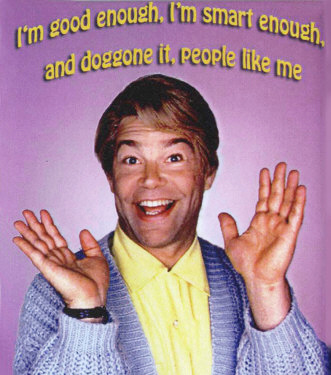
There used to be a character on Saturday Night Live named Stuart Smalley, who was the host of a fake self-help show (pictured above-haha). I never really watched it because I was young when it was on, but I have seen highlights of it on different SNL highlight shows. Anyways, the character in this sketch is obsessed with twelve-step programs, and is involved in a number of them. He isn't a trained therapist, just someone who is trying to overcome his own addictions and help others on this same journey. His famous line, as you can see from the picture above, is something that he would look in the mirror and repeat to himself as a positive affirmation: "I'm good enough, I'm smart enough and doggone it, people like me!" He had many catchphrases that poked fun at 'psychobabble' and self-help lingo. He even turned this sketch into a movie called Stuart Saves His Family--I had to watch it for a class once and write a paper on it :-).

Anyways, in an ironic twist of fate, Al Franken, who played the role of Stuart Smalley, is known also for his political work- he is currently a senator in the state of Minnesota and is advocating for eating disorders! Amy Klobuchar, also a Minnesotan senator, and Tom Harkin, a senator from Iowa, have teamed up to introduce a new bill which Franken is sponsoring. This bill is called the FREED Act (Federal Response to Eliminate Eating Disorders) and it's goal is to "allocate research money to the National Institutes of Health to better investigate the causes of eating disorders and improve treatment methods. The research would also seek to improve public data on eating disorders, including morbidity and mortality rates." This quote was taken from an article published in The Minnesota Daily and the article in its entirety can be read here. The gist though is summarized in a quote Franken gave to the paper- he said, "We don't know nearly enough about diagnosing, treating and preventing these diseases. [This] legislation is a major step forward in understanding eating disorders and how to stop them from destroying lives."

To put things into perspective, the NIH (National Institutes of Health) allows $1.20 towards research per person with an eating disorder, contrasted with $159 towards research per person with someone who has schizophrenia (whose prevalence is significantly less). That is pretty staggering!! Last week was lobby day for the Eating Disorders Coalition, and this was an exciting day for eating disorder advocacy! I have no political agenda that I push when I write my blog- however, I think it is important for us to know the facts and to be educated, and to be able to act if we feel moved to do so! To read more on this act and what it aims to do, follow this link. If you are interested in finding out how YOU can advocate for increased eating disorder funding for research, prevention and treatment, follow this link to write to your Congressperson!

Sunday, March 21, 2010

Bring Change 2 Mind

I just started watching a TV show recently called Modern Family. It is hilarious. I've only seen it a few times, so I'm not sure I can do the premise justice, but it's essentially a sitcom that chronicles different members of an extended family and their interactions. (If you're curious, follow this link to check it out.) Anyways, I really do like it, but last week when I was watching, one of the characters made a joke about eating disorders. It's hard to explain what happened since I don't really know any of the characters names, but one of the children was annoyed with his mother and said- "mom, go tend to your eating disorder or something." I'm not sure if this was supposed to be funny, but after the day I had, I was NOT laughing. An eating disorder is a mental illness, and there's nothing funny about that. I didn't turn off the TV and refuse to watch the rest of the episode, but it just struck me that if you replaced 'eating disorder' with any other mental illness- say, schizophrenia- it probably wouldn't be funny either. So why did someone think making a joke about an eating disorder would be funny? This just reminded me that eating disorders aren't widely viewed as psychiatric illness yet.

I think one of the biggest myths about eating disorders is that they are a lifestyle choice- not a mental illness. Yes, there is choice involved in recovery- you have to choose to take steps to recover. But an eating disorder is a mental illness, so it's not as simple as 'just eating'. Glenn Close, the actress famously known for playing Cruella Deville in 101 Dalmatians (ha ha, just kidding- I think she is famous for her role in Fatal Attraction, which I've never seen-- and some other movies too..), started a non-profit called Bring Change 2 Mind. The mission is to raise awareness about mental illness, to work towards de-stigmatizing it while also providing support for those who deal with mental illness. Close's sister and nephew, who both suffer from different mental illnesses, were the inspiration that fueled her to initiate this endeavor. PsychCentral wrote a little article awhile back in October when it launched - to read it, click HERE.

I'd encourage you to check out her site! I'll be honest- right now, there is a slightly annoying pop-up when you access the site, but that's just because Bring Change 2 Mind recently partnered with NAMI (National Alliance on Mental Illness) for NAMIWalks Campaign (a walking campaign to raise money for and awareness of mental illness!). The pop-up is a video, and even though it's slightly annoying, it's actually worth watching :) Once you get past the video, the site is great- there are resources for those who want to learn about mental illness or find support if they are struggling with one, there are videos of people sharing their stories, and there is additional information available that serves to encourage real understanding of mental illness! Right now, eating disorders are not part of their featured mental illnesses- they feature depression, post traumatic stress disorder (PTSD), bipolar, and schizophrenia. However, there are many mental illnesses, eating disorders included, that will hopefully be added as their non-profit grows! At this point, what seems important is that this is an organization that is dedicated to promoting awareness and knowledge about mental illness to de-stigmatize... which is awesome. If you are interested in finding out how you can be involved in any capacity, you can check out the 'be involved' tab on their site!

Thursday, March 18, 2010

Life Lessons by Goldilocks

It's a little funny that fairy tales and stories that were read to me as a little girl have been coming to mind lately. I'm not exactly sure what that means (haha), but what I would guess is that these stories come to mind because they actually have some good morals and principles rooted in them (that are not just meant for child-sized ears and lives) and are also relevant to daily happenings.

Today, through a couple of conversations that I had, I was thinking about and reminded of the extremes that we see in our culture when it comes to almost every single arena. Whether it's food, our bodies, and weight, or money, work, love, sex, success, sports, entertainment, etc.. extremes are everywhere. Whether it is an extreme diet, an extreme sport, an extreme behavior (like plastic surgery- Heidi Montag, anyone?), it seems that our culture is not only fixated on extremes but celebrates them. People are applauded and ridiculed based on their ability to conform to extremes. The media gives so much attention to extremes- whether these extremes are weight related or not. We are simultaneously fighting obesity as a nation, as well as a culture that fuels myths about eating disorders as a lifestyle choice. We are constantly made aware of great successes and great failures (which are defined and polarized by the media) and yet we don't necessarily have many positive role models that showcase what it's like to operate in a medium of balance- where both successes and failures are part of life, and where a gray area reigns, instead of the black and white. It seems to me that in a culture of extremes, one of the toughest things to achieve is balance. Outside of appearance and weight, some common questions that deal with balance include the following-- How much time do I spend working, and how much time do I spend playing? How much time should I spend with my family? How much time do I need to invest in cultivating my marriage/relationship? How much exercise is appropriate? How much time do I invest in my spiritual life? The questions can be endless and there is no sure answer for each individual. What I am sure of though is that we probably have a thing or two to learn from Goldilocks (strangely enough).

Goldilocks, for those of you who may need refreshing, broke into a cottage that belonged to three bears (probably not the part to emulate). She ate their porridge, sat in their chairs, and eventually fell asleep in one of their beds. The bears ended up returning home to find her asleep in one of their beds, and she ran out of the house, never to be seen again. Goldilocks is famous (to me, anyways) for the way in which she was a little picky, a little particular. When she tasted the bear's porridge, one bowl was too hot, and one bowl was too cold. But one was just right. The chairs and the beds were the same way-- not hot or cold, but too big, or too small, or too uncomfortable, etc. I guess the reason that she came to my mind today was because I think she is a good example of someone who was mindful of her surroundings and was able to make a decision based on what she felt was right in the moment. She may have been a little picky, but she noticed extremes and decided to operate in the gray area. While all of her options were benign and obviously not comparable to the kinds of things that I mentioned above regarding extremes, I think she is a good example of someone who is being mindful and balanced in her choices. I realize this is a bit of a stretch and may sound simplistic (it is), but I think being able to achieve balance is something that we really struggle with as a culture and as individuals.

This Goldilocks analogy does not apply to eating disorders (remember, EDs are a mental illness), but the analogy applies to the way that we view ourselves, perceptions of beauty, and life in general. So how do we work towards operating in the gray area so that we can live a life of balance? Being mindful, creating and maintaining boundaries, taking care of ourselves just as we take care of others, surrounding ourselves with kind and loving people, living out our values daily, and refuting and challenging irrational and negative thoughts/beliefs. Surely this list is not exhaustive. But I think by aiming to operate in this gray area and by finding a middle ground-- a balance, like Goldilocks did:)-- we might find that we are more content, that we feel better about ourselves, and that we become more accepting of ourselves and others. These are some of the things that give us character and ultimately make us beautiful.

To read about another children's story (the Velveteen Rabbit) and being real, follow this link.

Sunday, March 14, 2010

A few days ago, I read this article on the Huffington Post by Kimberly Dennis, MD, entitled Eating Disorders: Be the First Line of Defense. I wanted to re-post it here because it includes a lot of educational and statistical information that serves to re-iterate what eating disorders are. It also helps to dispel myths about eating disorders. It seems to me that the goal of this article is to provide a little bit of education to readers to help us become more aware, and possibly apprehend when a friend, loved one, or acquaintance may be exhibiting concerning behaviors related to food. This article is certainly not exhaustive, but I think it provides some basic info that everyone should know! I have copied and pasted the article below.

Eating Disorders: Be The First Line Of Defense

While the majority of us may not work in the emergency room, or even work in the healthcare industry, we can still save lives.

In the United States, as many as 10 million women and one million men are fighting a life-and-death battle with anorexia or bulimia, according to the National Eating Disorders Association. More often than not, dentists can provide the gateway to critical medical treatment for these individuals.

By becoming aware of certain signs and symptoms, you can uncover illness that may otherwise go unnoticed - and untreated. With the right knowledge, you can save a life.

A deadly disease spreads - faster

Eating disorders are potentially deadly, biologically-based psychiatric illnesses. Anorexia nervosa has the highest mortality rate of any psychiatric illness, nearly 12 times greater than any other cause of death among women between the ages of 15 and 24.

What's more, eating disorders among young women are increasing at an alarming rate. Nationally, the incidence of bulimia in women ages 10 to 39 tripled between 1988 and 1993, and continues to grow.

Anorexia typically begins at the start of puberty and is more common among adolescent girls and young adult women. It affects one to two percent of the female population, and 0.1 to 0.2 percent of men. Because more than 90 percent of all those who are affected are adolescents and young women, the disorder has been characterized as primarily a young woman's illness. But it should also be noted that males and children as young as seven years old have been diagnosed with this illness, as well as middle-aged and elderly women.

Patients are diagnosed with anorexia when their body weight falls to 85 percent or less of their normal, healthy weight. Typically, these patients have an obsessive preoccupation with body weight and calories, as well as an intense fear of gaining weight or becoming fat. Their body image is grossly distorted, resulting in an unwarranted psychological impact on how they see and value themselves.

There are two types of anorexia nervosa: the restrictive eating type and the binge-eating/purging type. Binge eaters rapidly consume a large amount of high-calorie food in a very short time - perhaps 1,500 to 3,000 calories or more. Those who purge may do so with self-induced vomiting, excessive exercise or the misuse of laxatives, diuretics or enemas. Approximately 70 to 80 percent of people with bulimia purge by means of self-induced vomiting, while 30 percent use laxatives. Some who purge, however, do so without actually binge-eating first.

Recognizing the danger signs

The physical complications associated with anorexia are potentially life-threatening, since dehydration and malnutrition can damage vital organs. This can result in:

- low blood pressure

- electrolyte imbalance

- cardiac arrhythmias

- thyroid gland deficiencies, which can lead to cold intolerance and constipation

- appearance of fine, baby-like body hair

- bloating or edema

- decrease in white blood cells, leading to increased susceptibility to infection

- osteoporosis

- seizures related to fluid shifts due to excessive diarrhea or vomiting

- kidney damage or failure from chronic use of diuretics

Signs of an eating disorder are:

• Exhibits concern about her weight and attempts to control weight by diet, refusal of food, vomiting or laxative abuse.

• Prolonged exercising despite fatigue and weakness.

• Peculiar patterns regarding handling food.

• Exhibits abnormally fast weight loss, without any other known medical condition.

• Experiences depressive moods and self-deprecating behavior.

If you recognize these signs, fight the urge to remain silent. Remember, denial is a big part of eating disorders - another reason they can become fatal and a major obstacle to recovery. Act in a caring and non-judgmental way, simply stating what you see, and asking how you can help.

Also, you can go to the Web site of the National Eating Disorders Association (www.myneda.org) or call Timberline Knolls at 877-257-9611, and we would be happy to help find a professional in your area. That referral just might save a life.

Kimberly Dennis, M.D., is the medical director at Timberline Knolls (www.timberlineknolls.com). Located in Lemont, Ill., this innovative residential treatment center is designed exclusively for women with emotional disorders, including eating disorders, addiction and self-injury behavior. Dr. Dennis is a member of the American Medical Association, the Academy of Eating Disorders, the American Academy of Addiction Psychiatry and the American Society of Addiction Medicine.