Showing posts with label mental illness. Show all posts
Showing posts with label mental illness. Show all posts
Wednesday, January 19, 2011
A Little Update...
Back in April, I felt inspired to re-post a blog that Nancy Matsumoto wrote regarding the dilemma of when to speak up and express concern over a friend's eating disorder. You can read that post here. Nancy is a blogger (she blogs over at Eating Disorders and Nutritional News), but she is also an accomplished writer, as well as a friend that I have mentioned on my blog many times. Recently, a reader of mine responded to that particular blog post and was really touched by what Nancy had written. I shared that with Nancy, who then wrote a follow up blog. If you are interested in checking that out (it's a good one!), follow this link. Thanks to Nancy for her kind and compassionate words on such a difficult topic!


Wednesday, January 5, 2011

Happy New Year, friends! While I planned on my first post of 2011 being lighthearted with some encouraging thoughts for the New Year (don't worry, those are coming soon), I felt like I needed to first address something that has been coming up the last few days in many conversations that I have had with friends and clients alike. French model Isabelle Caro died at age 28 after a long struggle with anorexia. She had been struggling with anorexia since her youth, the struggle spanning half of her short life. When she entered the world of modeling, she was already struggling with her eating disorder; however, the environmental pressures resulted in further triggering her into an extremely dangerous state which in 2005 ultimately led her into a coma. Doctors thought that she would not survive, but she came out of the coma, was discharged from the hospital and continued to model. She wanted people to see the devastating effects and impact that an eating disorder has on its sufferer, and as a result, she decided to pose nude for an Italian advertisement in 2007 in an attempt to de-glamorize the thin ideal. More recently, within the last few years, she had been on different television shows and news programs discussing her experience with anorexia. Her recent death is extremely upsetting- and this entire story has raised some really important questions for me.
First, in 2007, when Isabelle posed for this campaign, she reportedly said regarding her intentions and hopes for such a campaign.. "I've hidden myself and covered myself for too long. Now I want to show myself fearlessly, even though I know my body arouses repugnance. I want to recover because I love life and the riches of the universe. I want to show young people how dangerous this illness is. " I think what makes me so sad about this is that she wanted to recover, she wanted to live a full life, and yet she wasn't able to do it on her own. Anorexia is a mental illness, and it is extremely difficult for one to recover on her own. I guess I just wonder if her death could have been prevented. Why did the people around her continue to allow her to be the face of anorexia in the media, rather than helping her take the steps to health that she could not take on her own? I am not saying that her death is the fault of her acting coach, or booking agent, or doctor, or whomever, but when someone suffering from an eating disorder reaches a certain point (not just weight wise- but health wise), hospitalization/treatment is necessary for recovery. How is it that she was made famous by her eating disorder, and yet people stood by and let her continue in it? I'm angry that she was encouraged and supported to keep putting herself out there and it makes me wonder why the people closest to her did not stop her and lovingly get her the help that she needed. I know that the sufferer has to want to recover, and no one can force recovery, but it sounds like she did want to recover.. she just was not able to do it on her own, like so many others. I don't know if the people around Isabelle tried to get her into some kind of treatment, and I would have to imagine (or hope) that they tried at some point. But I think this whole story highlights both the nature of anorexia as a mental illness AND the importance of people receiving the appropriate care, treatment and help that they need-- and how sometimes that means that they NEED help from others in order to get there.
Secondly, the Italian fashion house that promoted Isabelle's 'no anorexia' campaign wanted to support Caro by using " the naked body to show everyone the reality of this illness, caused in most cases by the stereotypes imposed by the world of fashion. " I think that eating disorder education certainly needs to happen, and I respect the efforts of those involved to that end. What concerns me is that eating disorders are not caused by the fashion industry. Certainly the thin ideal, the unrealistic standard of beauty created by the media etc contributes, but if the fashion industry causes eating disorders, then why do we not all have them? It is because eating disorders are caused by many different factors, including significant genetic ones.
I guess all of this got me thinking again about helpful ways to educate people about eating disorders. How do we effectively portray the severity and danger of an eating disorder while also not plastering photos around that can be more triggering and harmful than good for people to see? When someone suffering from an eating disorder sees a deathly looking skeletal body and may not look the same, she may be tempted to think that she is not really suffering or struggling as badly, or that her health is not being impacted. And in some ways, images further stereotype what an eating disorder 'looks like.' One in four college aged women suffers from eating disorders, but that does not mean that one in four college aged women are walking around looking like skeletons... or that their eating disorders are any less of a threat to their health because of what they look like. I think we need to be careful about how we communicate about eating disorders. I don't know that I have any good global solutions at this point, but I think it's important and necessary to ask the questions.
In all of this, I am just sad that another life has been lost as a result of a devastating mental illness. I hope that her death is not in vain, and that she may serve as a reminder to all of us that anorexia (in addition to other eating disorders) is a real and dangerous illness that is capable of tragic outcomes when not treated.
Wednesday, November 3, 2010
Happy November!
 It's a new month, and with a new month, comes some good news from a recent study... Results from a national survey (conducted by the National Eating Disorders Association) reveal that the general public's awareness about eating disorders has dramatically increased. Great news! According to the study, 82% of people would agree that an eating disorder is a physical OR mental illness. 78% of people believed that they would know if someone was suffering from an ED, and 95% said if they knew someone that was suffering from an ED, they would help the person seek the appropriate help.
That is definitely progress and encouraging news. : ) One area that the survey highlighted was the fact that overall, specific knowledge about eating disorders has not increased and that the incidence of eating disorders has not declined. Rather than being discouraged by this part of the survey's results, it just reminds me that there is still a need to continue to raise awareness and educate people about eating disorders. There has been a lot in the news this week about eating disorders... between Portia de Rossi sharing about her eating disorder (maybe too explicitly!) and Demi Lovato, who quit her tour to allegedly receive treatment for an eating disorder. An interesting comment that Lynn Grefe (NEDA President) made is that too often we focus on trying to de-stigmatize mental illness and eating disorders, which can sometimes reinforce the stigma. She went on to say that having an eating disorder is no different than having any other illness (breast cancer, etc) and that we need to spend more of our time focusing on educating people, especially in light of this recent data. Two thumbs up, Ms. Grefe.
To check out more of the data from this survey, keep checking back in:) The link is through MedScape Med News and technical difficulties are interfering with the link attaching. You can also google 'NEDA survey MedScape' to find it as well!
Monday, October 4, 2010
On Asking For Help-- And A Horse Named Dude
 Last week, I took a little road trip to Virginia where I attended an onsite visit at Remuda Ranch. Remuda is a residential treatment facility for girls and women with eating disorders- they just recently updated their website, and it's worth checking out (follow this link to view it!). Anyways, while I knew quite a bit about Remuda Ranch before visiting, I was really impressed with the quality of care that they provide to patients. I was also impressed with the commitment and value placed on spiritual healing as well! Remuda's treatment program is centered around a Christian approach, however, girls and women of all faiths are respected and welcome and can decide how little or how much they want to participate and interact with the faith piece.
 Anyways, Remuda really is a ranch- it's not just called that:-). There is a full service barn complete with horses. No cell phone service, no Starbucks, and nothing but dirt roads and beautiful scenery. Among the therapeutic activities used with patients is equine therapy, which uses experiences and interactions with horses to teach the patients things about themselves, facilitating insight and growth. I was a little skeptical before I really knew anything about it, but after learning more and seeing different demonstrations, it is amazing how much you can learn about yourself from a horse!
I volunteered to help out with an activity and got to meet Dude, an Arabian horse:-). My task was to get him over a jumping bar without touching him. Last time I checked, I wasn't a horse trainer-- and I had NO idea how to make this happen. Once I was in the ring with Dude, I secretly regretted volunteering because I was feeling a little in over my head!! After several frustrating minutes of Dude eating dirt and ignoring my commands to jump over the bar, I finally asked Dave, the man in charge, if he had any suggestions! He didn't (of course), but some of the other therapists that were watching were able to give me some ideas. They told me to take the bar off of the jumping post, and lay it on the ground and have Dude walk over the bar. After much coaxing and guiding him from behind, Dude finally stepped over the bar!!
After processing what happened with Dude (I love that the horse's name is Dude, by the way), Dave mentioned that this particular activity can be useful in illustrating how important it is to ask for help!! He said that he will watch people struggling with an activity like this, not knowing what to do, and watching them get frustrated (like me!), and angry- and yet they don't ask for help. Or, if they do, they wait a really long time before asking. You might see how this applies to eating disorder recovery, and even more so, life!! We were not created to be alone, to have no support or community in our lives. And yet sometimes our pride or life circumstances keep us from reaching out and asking for help! Sometimes admitting we need help and are unable to do things on our own can be a huge step forward... and what a relief to know that we don't have to carry a burden all on our own! Sometimes we don't ask for help because we're not even sure of what we need! But just being able to share a burden with a friend, family member or loved one can be a way of reaching out for help and support.
Sunday, September 12, 2010

For those of you unfamiliar with TLC, it is the cable TV network that has brought us such gems as Jon and Kate Plus Eight, The Duggars: 19 Kids and Counting, I Didn't Know I was Pregnant and Toddlers and Tiaras. If my tone isn't giveaway enough, I won't elaborate any more on my opinion of these shows. [I will say, as a disclaimer, that my mind is just so blown by 'I Didn't Know I Was Pregnant'. How do these women NOT KNOW?!] Anyways, many people really like these shows- and that is just fine. What is not fine is that I just read an article in the LA Times about one of TLC's new shows, airing tonight, which follows people through their issues with food and disordered eating. The name of the show is called Freaky Eaters. Umm... FREAKY EATERS???!!
I would encourage you to follow this link, which will take you to a web page that will allow you to email the network directly and share your feedback with them. You probably have other thoughts in addition to those that I have written- in fact, I am sure that you do! And I would encourage you to share them with the network as well! Part of raising awareness and education is to advocate- and this is a very simple way to do that!
Monday, September 6, 2010
Staying Skinny Beats What??
A headline in August 12's USA Today caught my attention- Women: Staying Skinny Beats Sex. The first line of the article, written by Nanci Hellmich, reads, "For many women, weight control is more important than sex." The stats that back that up? Out of 1001 adults, 52% of women say they would prefer to go without sex for the summer than gain 10 pounds. Even more, according to this same research, more people would rather lose 10-20 pounds than receive a promotion at work!! That is crazy and sad but is a realistic indicator of what the majority of people in our culture value. [As a disclaimer, after hunting around to find out where these statistics came from, I found the answer to be a little self-serving--Nutrisystem!! For those of you who don't know, Nutrisystem is a diet company that is a contender in the billion dollar dieting industry in our country!]
Does anyone else see this drive for thinness as a problem? Why does being thin supercede other values in life, like career and love?! And why aren't we doing more to work on changing the unhealthy notions and beliefs about our weight and bodies? Why are magazines and media outlets making irresponsible comments and perpetuating eating disorder myths (check out one response to W Magazine here)? More education and awareness needs to be happening, and fast!! You can start today by educating yourself about eating disorders- the facts and the myths- by going to NEDA's website for more information! It is important to note that the media does not cause eating disorders. The media can pose a risk to someone who is genetically determined to develop an eating disorder, but it is not one thing that typically causes them. I would encourage you to think about what else can you do today to educate yourself (and others) and then raise awareness.. I would love to hear your ideas- you can post a comment or send me an email if you have any ideas!
Friday, August 13, 2010
Update: Another Pro-Ana Slogan, Snack Factory?! Really?
 If you didn't get a chance to check out my last post, scroll down and check it out... The Snack Factory, a company based out of San Francisco that makes different snack foods, recently began an ad campaign for their pretzel thin pretzel snacks by using a pro-anorexic advertisement. As you can see from the ad that is pictured in the post below (or you can click here to view it), this was a very offensive ad and the Snack Factory agreed to take it down. Well, believe it or not, this image to the left is what they replaced it with... "Tastes as good as skinny feels." Umm.... Hello!!! How is this any better than the previous one?? Are they just really that clueless or do they not care what the ad communicates?
I am going to give them the benefit of the doubt and assume that they are just really ignorant- but I think this again just highlights the need for a) more education and information to the general public about eating disorders and b) the need for continued advocacy and awareness being raised which may eventually help to change things like this that we see and encounter from day to day. It doesn't mean grand gestures. Maybe it means reading up on eating disorders (follow this link for great info on the NEDA site), encouraging your friends (and yourself!) to avoid fat talk, or maybe you point out myths about eating disorders when you have the opportunity! No matter what you do, there is nothing too small to help raise awareness. Every little bit counts.
I'm not sure if these ads are still up; I have not been able to find anything more on whether the Snack Factory pulled them or not. Hopefully they did. Please feel free to contact them and tell you how you feel about their ads if you are so inclined. Here is the link to their website and contact info!
Sunday, August 8, 2010
Think Before You Advertise

Just a few weeks/months ago, there was controversy surrounding a t-shirt that Urban Outfitters was selling on their website and in stores. It said "Eat Less." [I wrote a post about it that you can check out here.] Since then, the shirt has been pulled from stores as well as from the UO website. It just boggles my mind when a company endorses an idea like this- it really makes me wonder who signed off on this, thinking it was a good idea!!
Well, the Snack Factory, a snack company based out of San Francisco, is marketing their new pretzel thin pretzel snacks and has stirred up quite a controversy over their choice of creative advertising. The picture above is the ad, and while I try to avoid using triggering images, I thought that this image was relatively safe- and important to show! So, here is the Snack Factory's idea of clever advertising. Too bad their advertising campaign comes at the expense of millions of young women and men who struggle with this very lie that 'you can never be too thin'. In response, people in New York City have been covering these ads with pictures of emaciated women, and the phrase, "Actually, you can [be too thin]." The Snack Factory responded to complaints via Twitter by saying that they are "using the word ‘thin’ in a creative way to describe our product," and that people "seem to be interpreting it in their own way... we're a thin pretzel cracker!"
I get that they thought they were being cute and creative, but that does not make it appropriate or okay. When you choose to promote a pro-eating disorder belief as your advertising campaign, you have to take responsibility for it. Thankfully, the VP of marketing for the Snack Factory has heard the public outrage and is responding by pulling the pictures and ads. This is another reminder that speaking out makes a difference, and that we can truly make an impact! This is also a good reminder that more education about eating disorders is needed, and that we need to continue to bust the myths about eating disorders so things like this will become less frequent.
Tuesday, July 20, 2010
Project HEAL Q&A- Part Two

If you haven't had a chance to check out the first part of my interview with Project HEAL founders Liana Rosenman, Kristina Saffran, and Becky Allen, scroll down to my previous post or click here! These three teenagers are working hard to raise awareness about eating disorders, and they are also working hard to help people pay for their treatment by holding fundraisers and events. They have taken their own personal struggles with eating disorders and have used their experiences to give back and to help others. It sounds like this has been a helpful part of their own recovery! For the conclusion of my interview, continue reading below.
Me: What has this experience of giving back and helping others been like for you?
PH: It has been absolutely amazing! It is so rewarding to be able to speak with [our scholarship applicants] now and hear how our funding helped them regain their lives.
Our work with Project HEAL has also motivated us to stay strong and to remain fully recovered. We would never want to stand up in front of [people] presenting ourselves as people who we are not. We strive to be role models who are trying to recover and [role models] for everyone else dealing with body image issues. We would not want to be hypocritical.
4- If someone were interested in getting involved or donating to Project HEAL, what might you suggest they do? What opportunities exist to help?
If anyone would like to become involved with Project HEAL he or she should definitely contact us! We are interested in starting local chapters of Project HEAL at high schools and colleges. The main responsibility of the club would be to hold fundraising events including, but not limited to, bake sales, car washes, and the sale of Project HEAL merchandise. We would also encourage the club to hold regular meetings to discuss positive body image, self esteem, depression, etc. and to educate the younger grades on eating disorders. If someone would like to donate to Project HEAL or purchase Project HEAL merchandise, he or she is able to do so through our website. We also encourage everyone to look out for upcoming events on our website.
5- I work with a lot of young girls who have eating disorders, who struggle with the motivation to recover. I noticed a quote on your site: "We hope that people will be able to come to the same realization we have (without dealing with an eating disorder first!): We only live once so we must live it right. It is so much more fun to enjoy going out for ice cream with friends than to go running by yourself as punishment for eating an apple. Life really is worth living!" Having been there yourselves, what might you say to a peer, or a teenage girl, who is struggling?
In our opinion there are three key aspects to recovery:
1) Don't be afraid to admit you are struggling and need help -- Everyone deals with adversity. What truly separates us from one another is how we deal with that adversity; whether we let our adversity overcome us or whether we choose to overcome our adversity.
2) Remember that the physical weight gain almost always comes before one is actually comfortable with his or her body -- In the beginning food is like medicine. It is something our bodies need whether we want it or not. After (and during) weight restoration, we can work on our mentality- how we view ourselves. However, it is important to trust your treatment team. You may think you look overweight because mentally you are struggling. Trust your treatment team when they tell you that you are still too underweight. They are here to help, not harm, you.
3) Find a passion -- An eating disorder becomes one's identity. It consumes an individual and masks who he or she truly is. Thus, we encourage eating disorder sufferers to find something they love and to pursue that thing. Don't be afraid to try new activities no matter how old you are. Discover what you love, who you are. This will enable an individual to develop a new, healthy identity.
It is important to note that these young women are not trained therapists, but are women who have gone through their own personal struggles and are working to use their experiences to help others. If you are interested in finding out more about Project HEAL, follow this link to view their website. There are many ways to get involved- you can participate in a fundraising event, start a local chapter at your high school or college, you can donate money, or purchase merchandise from their site-- proceeds go towards scholarshipping individuals into treatment for an eating disorder. If you have any questions about Project HEAL, or would like to get more involved, you can contact them directly- their contact information is on their site, and is located here. A big thanks to the girls for all that they are doing to raise awareness and make a difference!!!
Friday, July 16, 2010
On 'Stigmatizing Health' and Orthorexia Nervosa

The Huffington Post is great at stirring up controversy with its opinion pieces. That's partly why I love it. It's a good (and fairly benign) forum for people to engage with different thoughts and think critically. What I don't love, though, is when people write things that are not accurate or informed. Case in point- the other day, someone wrote an article on orthorexia nervosa that was very misinformed. It's okay if people have differing opinions (based on empirical evidence) regarding how to effectively treat an eating disorder, or if people disagree on how we can improve and increase accessibility of treatment. What is tough though is when someone in a public forum, who has no psychological training, refutes the validity of a mental illness.
The article is HERE if you are interested in checking it out. Or, I can save you the four minutes and give you a brief synopsis. In all honesty, you might want to read it just to get a sense of her perspective, but Christina Pirello argues that orthorexia nervosa has been made up by psychologists and health professionals in order that the status quo is maintained, which essentially fuels an industry (pharmaceutical) created to profit from our unhealthy eating. She believes that healthy eaters should not be marginalized for choosing to eat healthily and that healthy eating does not equate with being mentally unstable. While I agree with her on that last part, I think the problem with her argument is that she really doesn't get that eating disorders are not a lifestyle choice, like healthy eating is. Eating disorders are a mental illness. Someone who suffers from an orthorexia is no more choosing to eat healthy than someone who suffers from bipolar disorder chooses to have a mood disorder.
Orthorexia nervosa is not just the desire to eat healthy. Orthorexia interferes with one's ability to live a normal, high functioning life due to the pursuit of eating only pure and healthy foods. This may mean avoiding work, family and social commitments or events to avoid having to eat anything that is not pure, raw or healthy. Orthorexia is also pathological in nature. This means that the disorder goes beyond someone's desire to adhere to healthy eating; there are negative consequences that result from the behavior. If someone is just eating healthily, that is not pathological! It is pathological though when this pursuit of healthy eating interferes with one's ability to lead a normal life. The preoccupation with healthy eating can become an interference in everyday activities, relationships and life. It also becomes pathological when one's health is compromised. Often, one who is orthorexic may avoid eating anything but fruits and veggies- the way that this can affect one's body can be detrimental. Your brain needs carbs to function properly (maybe Pirello needs some carbs!) and your body needs other essential nutrients that cannot be utilized from a handful of foods. While I can appreciate a perspective that is different than my own, my fear is that Pirello's perspective serves to further perpetuate myths about eating disorders. For more information on orthorexia nervosa, follow this link.
Friday, June 25, 2010
EDNOS

I have posted in the past (here) about 'eating disorders not otherwise specified' -- commonly referred to as EDNOS. As a diagnosis, EDNOS is not very specific-- if one does not meet the criteria for anorexia or bulimia, then he or she is lumped into the EDNOS diagnosis. In this way, it can sometimes be seen as the 'kitchen sink' diagnosis. This can be problematic for many reasons-- mainly, a single diagnosis used for people that experience a range of different behavioral symptoms (binge eating- no purging, purging- no bingeing, night eating, etc) is not necessarily effective when it comes to treating the eating disorder. There was an article published in the NY Times awhile back that I have been meaning to post that you can access by following this link which addresses this very issue. I would encourage you all to check this article out! It helps to bust a few common eating disorder myths and provides a little more background on EDNOS. For more info on EDNOS, follow this link.
Sunday, June 20, 2010
More on The Biggest Loser...
 Back in April, I wrote about The Biggest Loser. Actually, I didn't really write about it so much as just post a link to a great article about it that someone else wrote! Follow this link to check out the post and article. Or if you didn't read that post (or the article) and don't feel like doing it now, I'll try to provide a quick re-cap : ).
 First, I know that there are a lot of people who love watching this show (including some of my friends and family- hi guys!). This critique is not meant to encourage anyone to stop watching the show, but more so just to encourage critical thinking about what really is going on and if it is healthy! I watch a little TV that is regularly critiqued for many reasons (the bachelorette, for one- haha), so believe me, I am not throwing stones. But my overall thoughts on the show can be summarized by saying that the show seems to perpetuate some pretty unhealthy views regarding weight, body image, health, and happiness, as well as unhealthy, immoderate and unsustainable practices (exercising up to 6 hours a day?). The only reason that I bring this whole thing up again is because an article was published a few days ago by Kate Ward on Entertainment Weekly.com entitled "Former 'Biggest Loser' Contestant Claims Show is 'Dangerous'; NBC Issues Response." In light of my post a few months back, I thought that this article was an interesting follow up. Check out this link to view the article, or read the copy and pasted version for your convenience below! If you all have any thoughts or comments about this, I would love to hear them (as always)!
About twice a year, we tune into the latest season of The Biggest Loser and watch in admiration and awe as a dozen or so contestants quickly shed pound after pound from their bodies, until they’re left looking like healthy, happy individuals. But, if former contestant Kai Hibbard is to be believed, oftentimesBiggest Loser graduates are anything but.
The season 3 contestant — who lost 118 pounds on the show — appeared on CBS’ The Early Show this morning to discuss her claim that the NBC show is hurting its contestants, and promoting an unhealthy body image. (See the video embedded after the jump.) Beginning her interview by voicing appreciation for being part of something that has inspired people to lose weight, Hibbard went on to accuse Biggest Loser of supporting a “myth that’s dangerous,” and claims the show stretches the truth when it comes to its shooting schedule: “I have people that come up to me and talk to me and ask me why they can’t lose 12 pounds in a week when I did. It didn’t happen. It’s TV…a week is not a week in TV.” (Hibbard also discussed dehydration, which is used to affect the outcome on the scales, something Biggest Loser fans are already fairly knowledgeable about.)
The former contestant also went on to explain how Biggest Loser affected her own health:Hibbard says she suffered from an eating disorder after shooting wrapped, which only ended after her husband and friends staged an intervention when they saw her substitute coffee for meals, and began to notice her hair falling out. “I left with a very poor mental body image,” she said on the Early Show. “I found myself loathing what I looked like the more weight that I dropped because of the pressure on me.” What’s more, Hibbard claims at least six former contestants from seasons after hers have approached her to complain about their own unhealthy experiences.
When asked to comment, NBC issued the following statement to EW: “Contestants on The Biggest Loser are closely monitored and medically supervised. The consistent health transformations of over 200 contestants through nine seasons of the program speak for themselves.” Of course, Biggest Loser is not new to controversy — nearly every season, the show comes under fire from viewers and health professionals alleging the show’s lose-weight-fast format is unhealthy for its cast members, especially since the show seems intent on adding bigger and bigger cast members with each new season. (Just see the latest Biggest Loser winner, Mike Ventrella, the heaviest contestant to ever enter the ranch.) But now that a former contestant is alleging the show is dangerous, is it easier to believe?
Monday, June 14, 2010
Race For The Cure and Body Image
 The Susan G. Komen Race For The Cure took place in Raleigh, NC this past Saturday, and it was such an inspiring event. It held special meaning for me, as I have a grandmother and an aunt who have both battled breast cancer-- and survived!!! My aunt was actually in town from Oregon for follow up care at Duke, and so we formed a group and all participated together in this event. I have heard that participating in a Komen race is very different than other races, and as a first time participant, I think I saw why. First, there were SOOO many people that participated. If you look at the picture below-- it is a little tough to make out-- but as far as you can see, there are people that fill up the streets.
  The other thing that seemed different to me was the heart and spirit in this event. I think that most people participating had been touched in some way by breast cancer. While my grandma and aunt are survivors, not everyone wins their battle with breast cancer. One of my friends that participated on our team lost her mother to breast cancer. Many, many people have lost loved ones to this illness and it is really heartbreaking.
 The picture below is actually a shot of a few of the women that were on our team-- "Breast of Friends" : ) and you will notice the hot pink paper on these women's backs. These hot pink sheets of paper served as memorials to write names of people that you were walking in celebration of (survival), or in memory of, for those who have passed away. It was really sobering and emotional to see all of the names of people who have lost their lives to this illness. I think anytime, with any illness or disease, seeing names or faces make an impact because it personalizes the illness. In talking to my aunt over the course of her visit to Raleigh, she shared with me that battling and surviving breast cancer has changed her life and the way that she lives it in so many ways. One thing that she said that stood out to me was that she is thankful every single morning when she wakes up and realizes how blessed she is to be alive, and to have a body that works and is healthy.
 This really impacted me and made me consider how her wise words can be applied to those of us who have not battled breast cancer! First, I think that her attitude of thankfulness is one to be emulated. There are a million ways that having an attitude of gratefulness and thankfulness can impact us-- as well as those around us. Whether it means that we worry a little less, we appreciate what we have more, or take our eyes off of what we lack and what we wish we had and focus on what we do have, it is always good to have perspective, and to live in a way that reflects that attitude.
 This really impacted me and made me consider how her wise words can be applied to those of us who have not battled breast cancer! First, I think that her attitude of thankfulness is one to be emulated. There are a million ways that having an attitude of gratefulness and thankfulness can impact us-- as well as those around us. Whether it means that we worry a little less, we appreciate what we have more, or take our eyes off of what we lack and what we wish we had and focus on what we do have, it is always good to have perspective, and to live in a way that reflects that attitude.
 Secondly, I think that this relates to body image and the ways that we think of and care for our bodies. I want to be clear, like I am often, that eating disorders are a mental illness. Part of having an eating disorder (diagnostically) is experiencing a severe disturbance and preoccupation with one's weight, shape, size, body-- so this is in no way meant to minimize the severity and nature of these thoughts. What I will say though, is that for those of us who struggle with body image and have a negative self-image, this may be a good reminder and an encouragement about all that our bodies can do for us, and how blessed we are to have bodies that are able to function how they are supposed to, that allow us to be active, and that allow us to experience life! Yes, it may be upsetting when our jeans fit more snug; yes, it may get you down when you flip through a magazine and see nothing but airbrushed 'beauties'; and yes, it may be frustrating when you don't feel good about yourself! These are all feelings that most women have experienced before, so you are not alone! But I will encourage you with the words of my brave aunt, who said that she wakes up every morning, thankful to be alive and to have a body that works. Rather than focus so much on the way that our bodies look, maybe if we start to appreciate all that our bodies do for us, and the fact that they allow us to experience life, we may begin to embrace our bodies a little more and appreciate them for what they are and what they do for us.
Thursday, June 10, 2010
 Some of you may have heard about the t- shirt that Urban Outfitters recently pulled from their online catalogue after much hate mail was received. The shirt said 'Eat Less' and was featured on a waif-y model. It is hard to believe that they actually went there! But they did, and while it may have been to generate some publicity (tacky, much?), enough people protested that they thankfully took it off of their website. I also heard that the shirt has been pulled from stores--so hopefully that is true!
A couple of my therapist friends who I got to know while doing some contract work at the Carolina House brought an awesome article to my attention that I just have to share. Below is this article that was published in Durham's Independent Weekly newspaper and written by Rebekah L. Cowell (follow this link to see the article) about some local women who are in recovery and working towards exposing myths about eating disorders that this t-shirt's message was perpetuating.
Amy Lambert used to tell herself what Urban Outfitters is telling millions of other young women: Eat Less.
It wasn't unusual for Lambert, who had an eating disorder for more than eight years, to consume little more than one container of yogurt in a day. Now recovering, Lambert led a protest last week outside of Urban Outfitters at Southpoint mall in Durham.
Last week, Urban Outfitters placed in their online catalogue a gray V-neck T-shirt worn by a rail-like young woman. On the front, in script, the words "Eat Less."
"Urban Outfitters targets a young demographic, and they are reinforcing the idea that eating disorders are a choice, not an illness," she said.
Four other women from a Durham Eating Disorder Support Group joined the peaceful protest, brandishing signs that read, "Messages Can Re-Enforce Deadly Beliefs" and distributing fliers titled "Messages in Media: 'Eat Less' is Humor That's Not Funny."
Mall security shut down the protest 30 minutes later.
"We want to make it a friendly family environment," said Public Safety Officer Sellers, who refused to disclose her first name. "We can't just have people here doing that [protesting and handing out literature]."
Urban Outfitters did not return the Indy's calls or e-mails regarding the ad campaign, but after national outcry the T-shirt was removed from the chain's website, though the shirts that have already been shipped will be in stores. When the Indy visited the store and asked for the T-shirt, it was not on the sales floor. An employee who didn't want to be named called the slogan "harsh."
At least 24 million Americans suffer from eating disorders, which have the highest mortality rate of any mental illness. Twenty percent of people with an eating disorder will die prematurely from complications related to their disease. Telling an individual with an eating disorder to "eat less" aggravates emotional, psychological and physical issues. And for those still stuck in dangerous patterns, it is a message of validation, says Chase Bannister, clinical director for Carolina House.
In fact, the T-shirt has been posted on "pro-anorexia" sites as a source of "thinspiration."
"The banner-statement 'Eat Less' can be a stinging trigger for women and men with anorexia, bulimia or binge-eating disorder," Bannister added, "ultimately providing reinforcement for the distorted belief our patients work so hard to stamp out: 'I will never be okay unless I'm thin.'
The women said by holding the protest, they sought to empower themselves and spread a message of acceptance for a healthy body. Sandy Yarnall had anorexia for more than half of her life. She finally received treatment in 2008. "I struggle every day with wanting to go back to a very unhealthy size, and where I was before recovery, and seeing that message did distress me."
Rebecca Clemins has had an eating disorder for 25 years. "Urban Outfitters put this tee on a waif-like model, which enforces the idea that being waif-like is preferred, and they are encouraging a lifestyle that is killing young women," she said.
"I can't imagine endorsing something that creates so much misery," said Carson Hadley, who developed her eating disorder in eighth grade. She had to drop out of high school during her senior year to get in-patient treatment at Carolina House. "That shirt reminded of what I can't be if I want to live."
I am so proud of the women who participated in this protest, shared their stories, fought to raise awareness and exposed myths about eating disorders. This can certainly be an inspiring act for those with eating disorders who are working towards health to see- that not only is recovery very possible, but that it can also be empowering to take a stand and work towards educating people about the truth about eating disorders.
Monday, May 31, 2010
Athletes and Eating Disorders- Part 2

Below is NEDA's description of this term/phenomenon:
The Female Athlete Triad includes 1) disordered eating, 2) loss of menstrual periods and 3) osteoporosis (loss of calcium resulting in weak bones). The lack of nutrition resulting from disordered eating can cause the loss of several or more consecutive periods. This in turn leads to calcium and bone loss, putting the athlete at greatly increased risk for stress fractures of the bones. Each of these conditions is a medical concern. Together they create serious health risks that may be life-threatening. While any female athlete can develop the triad, adolescent girls are most at risk because of the active biological changes and growth spurts, peer and social pressures, and rapidly changing life circumstances that go along with the teenage years. Males may develop similar syndromes.
The Female Athlete Triad puts female athletes at risk, and also inhibits their athletic performance. I am glad Nancy mentioned this because it is something that not many people know about (even in the field of eating disorders!). Below are the last few questions/answers of my interview with Nancy- I hope that you will find this informative (like I have)!

Nancy: One thing I’ve learned about athletics and eating disorders is that for the coach, the line between encouraging athletes to achieve peak performance levels and promoting unhealthy eating and training behaviors is blurred. For this reason, when coaches and trainers, are told they need to be more vigilant in spotting and addressing dangerous behaviors it can sound to them like their ability to do their jobs is being questioned and curtailed. They want to create winning athletes, and the traits that create champions—perfectionism, the desire to please coaches, and strong drive to succeed—are those often associated with eating disorders. They may fear that in order to encourage healthier behaviors among their athletes, they will have to discourage the very traits that make their athletes excel. What we hope the Toolkit will do is show that the better nourished and healthier the athlete is, the better her or his performance will be, and that although eating-disordered behaviors may seem to improve performance in the short run, in the long run they do not support athletic excellence.
Me: For many elite athletes who are competing at world class levels (whether collegiately, professionally, in the Olympics, etc), particularly in sports that may encourage (implicitly or explicitly) a high degree of scrutiny over body composition and weight for performance purposes (gymnastics, ice skating, running, wrestling, etc), eating disorders and disordered eating are increasing. Do you have any thoughts about how we might work towards helping athletes approach their performance and bodies from a more healthy standpoint?
Nancy: Yes, education and support for both athletes and coaches is very important. Some coaches are still not fully aware of the risks for and dangers of eating disorders among their athletes. We hope that once they do understand the facts, they will be open to discussing these risks with the team, stop making negative comments about weight or size, establish a zero tolerance policy for eating disordered behaviors, and foster a climate in which an athlete feels she or he can discuss these issues without fear of reprisal. For athletes, it’s great to have a sports nutritionist speak to the team about the importance of adequate fueling and hydration in their sport, to go over the warning signs for problem eating and exercise behaviors, and to encourage them to seek help at the earliest signs of a problem.
A lot of these strategies are about de-stigmatizing eating disorders, making athletes understand that disordered eating and eating disorders are a common problem among athletes, and that they can and should be discussed. Athletes should also know where there is help available, and that these problems can be solved with the right professional treatment. In many athletic settings, lack of knowledge about eating problems creates a climate of fear among eating-disordered athletes that makes it very difficult for them to admit to this problem. This causes a lot of suffering in silence. All the recovered athletes I spoke to talked about the tremendous stress of having to perform while also sustaining their disorder in secret.
Sunday, May 2, 2010
The FREED Act
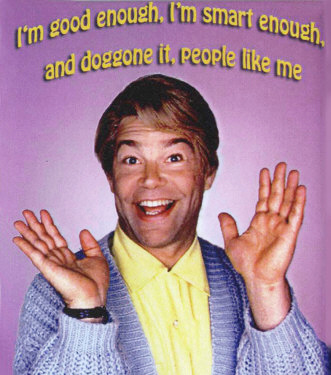
Anyways, in an ironic twist of fate, Al Franken, who played the role of Stuart Smalley, is known also for his political work- he is currently a senator in the state of Minnesota and is advocating for eating disorders! Amy Klobuchar, also a Minnesotan senator, and Tom Harkin, a senator from Iowa, have teamed up to introduce a new bill which Franken is sponsoring. This bill is called the FREED Act (Federal Response to Eliminate Eating Disorders) and it's goal is to "allocate research money to the National Institutes of Health to better investigate the causes of eating disorders and improve treatment methods. The research would also seek to improve public data on eating disorders, including morbidity and mortality rates." This quote was taken from an article published in The Minnesota Daily and the article in its entirety can be read here. The gist though is summarized in a quote Franken gave to the paper- he said, "We don't know nearly enough about diagnosing, treating and preventing these diseases. [This] legislation is a major step forward in understanding eating disorders and how to stop them from destroying lives."
To put things into perspective, the NIH (National Institutes of Health) allows $1.20 towards research per person with an eating disorder, contrasted with $159 towards research per person with someone who has schizophrenia (whose prevalence is significantly less). That is pretty staggering!! Last week was lobby day for the Eating Disorders Coalition, and this was an exciting day for eating disorder advocacy! I have no political agenda that I push when I write my blog- however, I think it is important for us to know the facts and to be educated, and to be able to act if we feel moved to do so! To read more on this act and what it aims to do, follow this link. If you are interested in finding out how YOU can advocate for increased eating disorder funding for research, prevention and treatment, follow this link to write to your Congressperson!
Subscribe to:
Posts (Atom)